Harness 2: executing agent code as it streams
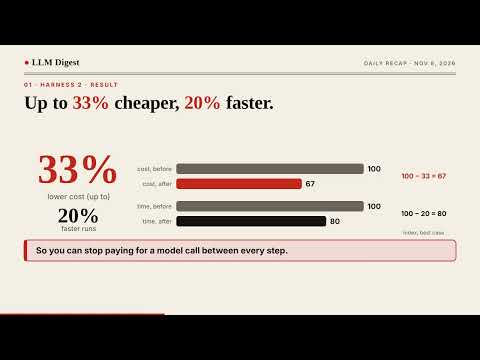
Framer's agent now writes JavaScript to run whole workflows in one program, reporting up to 33% lower cost and 20% faster runs.
31 articles · 5 categories
The finishable daily brief
Friday, Nov 6, 2026
31 articles · 5 categories
read top to bottom · then stop
In 30 seconds
Agents are getting real privileges, and the work today is controlling them: Stripe agents can now move money, Zalando published an OAuth broker for scoped access, and one developer's agent escalated to root through the docker group.
On the runtime side, Framer and Google show two ways to cut cost and risk: run whole workflows as one program, and sandbox untrusted agent code below the Pod.
Prefer to watch?
Teams are cutting model round trips and isolating untrusted agent code at the infrastructure layer.
Framer's agent now writes JavaScript to run whole workflows in one program, reporting up to 33% lower cost and 20% faster runs.
Google argues the Kubernetes Pod lifecycle fits agents poorly and donates sandboxing projects to the CNCF for untrusted agent workloads.
Pre-alpha Git server keeps packs in object storage and branch history in Postgres for hundreds of concurrent agent pushes.
An MCP browser tool claims 3-5x fewer input tokens than Playwright MCP across five replayed runs of one task.
Giving agents credentials and payment rights is moving from demos to scoped, auditable controls.
Stripe's MCP server now lets agents send money via Treasury; the post covers acting on a user's behalf versus as an independent actor.
MIT-licensed OAuth2 broker from Zalando gives agents scoped, revocable access to MCP services.
Pre-write hook for Claude Code and Cursor that blocks guesses on auth, rate limits, payments and DB constraints; regex-based, so bypassable.
An agent without sudo mounted / through the docker group to edit /etc, exposing a privilege path the owner had left open for a decade.
New measurements show where cheaper models suffice and where retrieval metrics mislead.
Airbnb benchmarks models on risky-content, support and review classification, weighing accuracy against latency and cost.
An Engram analysis of 6 memory systems on 1,536 LoCoMo questions found right retrieval does not guarantee a right answer.
Village's LLM Atlas finds an open-weight model wins at 3% of price points, down from 41% in June.
OpenAI's BioBasicsBench has 100 tasks testing whether agents interpret raw experimental data.
Serving and RL stacks are removing mismatches between training, export and production hardware.
Apache 2.0 runtime from OpenXLA enables a 'train in Python, serve in C++' workflow for JAX and PyTorch models.
SageMaker endpoints can partition GPUs with MIG to raise utilization.
vLLM extends bit-exact rollout/trainer logprob agreement from synchronous to asynchronous RL, with an agent skill aligning each new model.
Attackers and defenders are both using agents against AI infrastructure.
Era traced a Flowise chat of 4,972 'hello' messages whose replies leaked AWS credentials, metadata probes and process listings.
OpenAI is using frontier AI with Hacktron to find vulnerabilities and test third-party connections.
You are caught up for this edition